
Your phone buzzes. You check it. An email pops up. You open it. A notification dings. You swipe. Before you realize it, two hours have vanished into the void of infinite scrolling, and your brain feels like a browser with forty tabs open. This isn't just bad time management; it is digital overload, a state where constant connectivity exhausts your cognitive resources. The solution doesn't require throwing your smartphone into the ocean. It requires hitting pause. Enter meditation, which acts as a reset button for an overstimulated nervous system.
We live in an attention economy. Apps are designed by behavioral psychologists to keep you hooked. Every ping triggers a dopamine release, conditioning your brain to seek the next hit. But this constant switching costs you. It fragments your focus, spikes your cortisol levels, and leaves you feeling mentally foggy even after a full night's sleep. Meditation offers a counter-strategy. It trains your brain to return to a single point of focus, building the mental muscle needed to resist the pull of notifications.
The Science of Screen Fatigue
To understand why meditation works, we first need to look at what screens do to us. Digital eye strain is just the tip of the iceberg. The real damage happens in the prefrontal cortex, the part of your brain responsible for decision-making and impulse control. When you constantly switch between tasks-checking Slack, then Instagram, then an email-you engage in 'task-switching.' Research from the University of California, Irvine, shows that once interrupted, it takes an average of twenty-three minutes to get back on track. Multiply that by ten interruptions a day, and you lose nearly four hours of deep work.
This state creates a background hum of anxiety known as 'continuous partial attention.' Your body stays in a low-grade fight-or-flight mode because it never gets a chance to fully rest. Heart rate variability (HRV) drops, indicating stress. Meditation reverses this. By focusing on the breath or a mantra, you activate the parasympathetic nervous system-the 'rest and digest' mode. This lowers blood pressure, slows breathing, and signals safety to the amygdala, the brain's fear center. It is not magic; it is physiology.
How Meditation Rewires the Brain
You might think meditation is about emptying your mind. That is a myth. If you try to stop thinking, you will fail within seconds. Instead, meditation is about noticing when your mind has wandered and gently bringing it back. This simple act strengthens the anterior cingulate cortex, an area linked to error detection and emotional regulation. Think of it like lifting weights for your attention span.
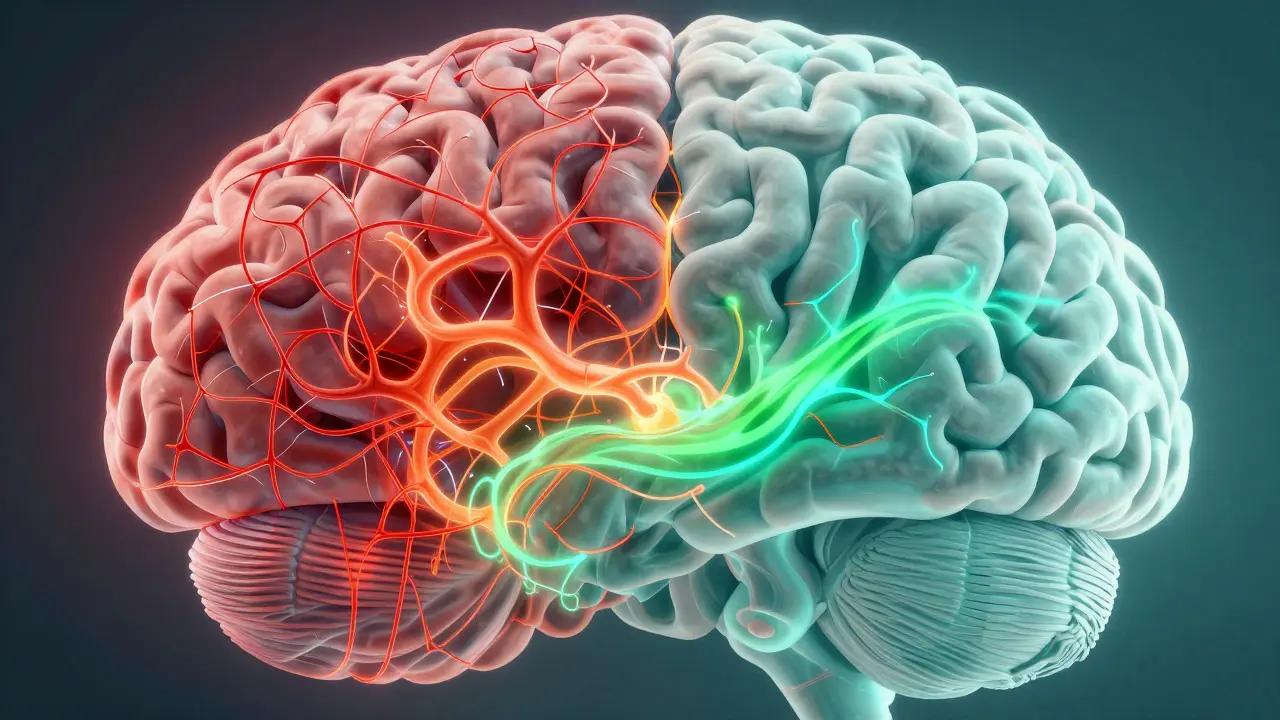
Neuroplasticity allows the brain to change structure based on repeated activities. Just as running builds leg muscles, daily meditation builds neural pathways associated with focus and calm. Studies using MRI scans have shown that regular meditators have increased gray matter density in areas related to learning, memory, and empathy. More importantly, the connection between the default mode network (DMN)-the part of the brain active when you are mind-wandering-and other regions becomes less rigid. This means you are less likely to get stuck in loops of worry or rumination when you step away from your screen.
| Aspect | Social Media Scrolling | Mindful Meditation |
|---|---|---|
| Cognitive Load | High (constant processing) | Low (focused attention) |
| Dopamine Effect | Spikes then crashes | Stable baseline |
| Attention Span | Fragments rapidly | Strengthens over time |
| Stress Response | Increases cortisol | Decreases cortisol |
| Post-Activity Feeling | Drained, anxious | Clear, rested |
Practical Techniques for the Digitally Exhausted
You don't need a retreat in the Himalayas to start. In fact, starting small is crucial. If you are used to high-speed internet, sitting still for thirty minutes will feel impossible. Begin with three minutes. Here are three specific techniques tailored for people suffering from digital burnout.
- The Box Breath: Inhale for four seconds, hold for four, exhale for four, hold for four. This rhythmic pattern forces your nervous system to slow down. Do this while waiting for a page to load or before opening your email inbox.
- Body Scan: Lie down or sit comfortably. Start at your toes and slowly move your attention up through your body. Notice tension in your jaw (from clenching during calls) or shoulders (hunched over keyboards). Acknowledge the sensation without trying to change it immediately. This grounds you in physical reality rather than digital abstraction.
- Open Monitoring: Sit quietly and observe your thoughts as if they were clouds passing in the sky. Don't chase them, don't judge them. Just notice. When you catch yourself planning your next text message, label it 'thinking' and return to your breath. This builds the gap between stimulus and response.
Consistency beats duration. Five minutes every day is far more effective than one hour once a month. The goal is to create a habit loop that competes with your phone-checking reflex.

Creating a Digital Boundary Ritual
Meditation works best when paired with intentional boundaries. Without limits, the noise will always flood back in. Create a 'tech curfew.' For example, no screens one hour before bed. Use this time for journaling, reading a physical book, or meditating. Replace the blue light with warm lighting to support melatonin production.
Turn off non-essential notifications. Ask yourself: Does this alert require immediate action? If not, mute it. Batch your communication. Check email at set times (e.g., 10 AM, 2 PM, 5 PM) rather than continuously. During these gaps, use micro-meditations. Before unlocking your phone, take three conscious breaths. This small pause breaks the automatic pilot mode and gives you a choice: Do I really need to check this right now?
Overcoming Common Obstacles
"I don't have time." We all say this. But consider how much time you spend doom-scrolling. Reclaiming fifteen minutes a day is not a loss; it is an investment in your mental clarity. "I can't quiet my mind." Remember, meditation is not about stopping thoughts. It is about changing your relationship with them. If your mind wanders, you haven't failed. You've succeeded in noticing it. That is the rep. "It feels boring." Boredom is a sign of healing. Your brain is detoxing from hyper-stimulation. Embrace the boredom. It is the space where creativity and deep thought begin to emerge.
Start today. Put the phone down. Close the laptop. Take five minutes to just be. Your brain will thank you.
How long does it take for meditation to reduce digital stress?
Most people report feeling calmer after just one session. However, structural changes in the brain and significant improvements in attention span typically require consistent practice for eight weeks. Daily sessions of 10-20 minutes yield the best results for rewiring habits.
Can guided meditation apps help with digital overload?
Yes, but with caution. Using an app to escape apps can be ironic. Choose apps that allow offline downloads and minimize notifications. Look for features like 'focus modes' that block other distractions during your session. Eventually, aim to transition to unguided silence to strengthen independent focus.
What is the best time of day to meditate for screen fatigue?
Morning meditation sets a calm tone for the day, preventing reactive scrolling. Evening meditation helps decompress from the day's digital input and improves sleep quality. Mid-day breaks (5-10 minutes) are excellent for resetting focus after intense screen work.
Does meditation improve productivity?
Yes. By reducing task-switching and improving sustained attention, meditation allows for deeper work. Studies show that mindful individuals complete tasks faster and with fewer errors because they are fully present, rather than partially distracted by digital notifications.
Is meditation suitable for children experiencing digital overload?
Absolutely. Children's brains are highly plastic. Short, playful mindfulness exercises (like 'listening to sounds' or 'breathing like a balloon') can help kids regulate emotions and improve focus. It teaches them healthy coping mechanisms instead of turning to screens for comfort.